
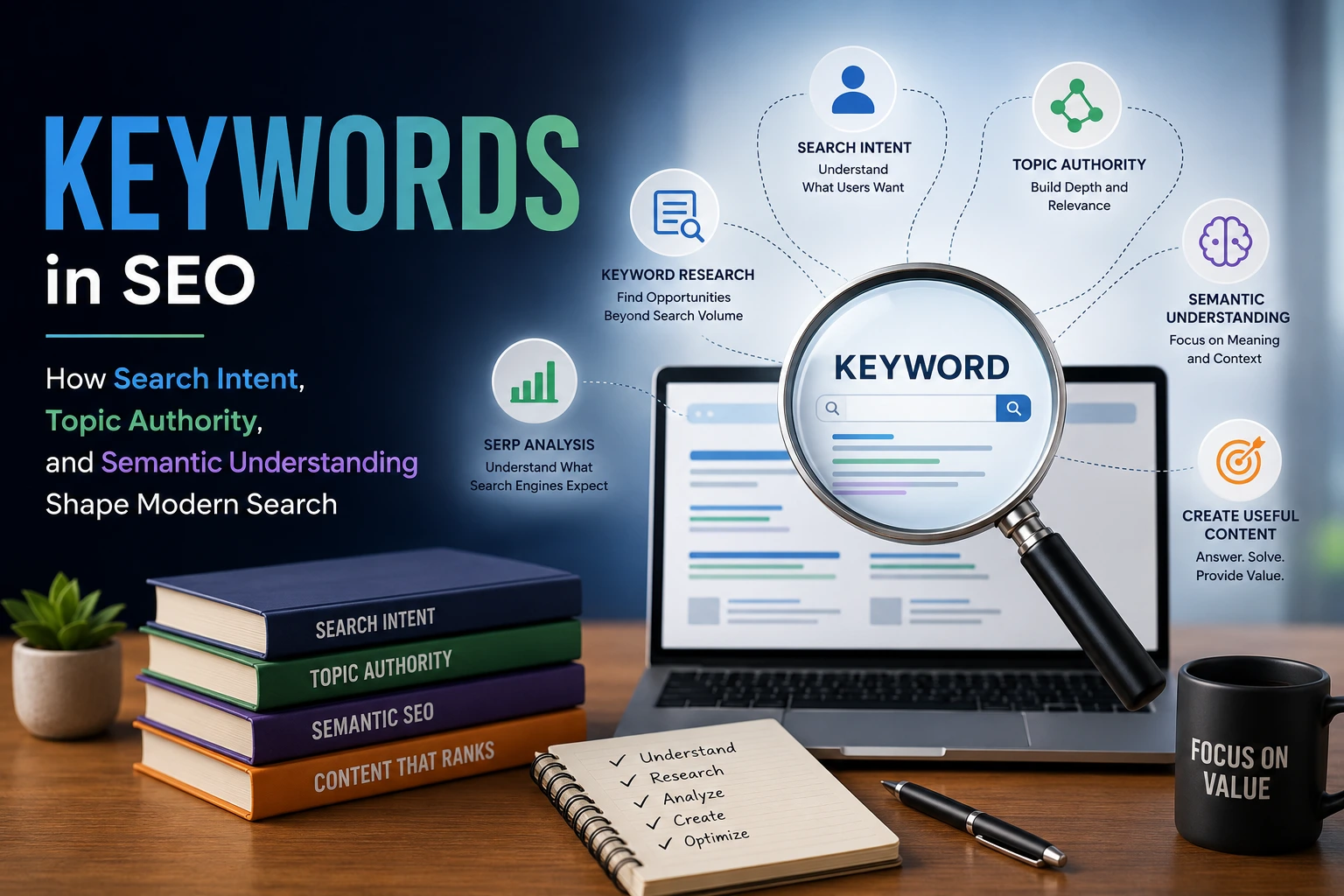
Keywords have always been one of the foundations of Search Engine Optimization (SEO).
They help content creators understand what people are searching for, help businesses identify opportunities, and help search engines connect users with relevant information.
However, the role of keywords has changed dramatically.
In the early days of SEO, keywords were often treated as exact phrases that needed to appear repeatedly throughout a webpage. Many optimization strategies focused on keyword density, exact-match targeting, and placing specific phrases in titles, headings, and content.
Modern SEO is fundamentally different.
Search engines no longer evaluate pages by simply matching words. They analyze meaning, context, relationships between concepts, content quality, and how effectively a page satisfies the user’s goal.
Today, keywords are not just terms to rank for.
They are signals that reveal user intent, topic relevance, and the information users expect to find.
The goal of modern keyword optimization is not to repeat a phrase.
The goal is to understand the searcher and create the most useful, complete, and trustworthy answer.
1. Keywords Are Signals of User Intent
Every keyword represents an underlying need.
A person searching online may be trying to:
- Learn something
- Solve a problem
- Compare options
- Find a specific resource
- Make a purchase decision
The keyword is only the surface expression. The real objective is hidden behind the search.
For example:
“best laptops for graphic design”
is not simply a keyword.
It suggests that the user may be looking for:
- Product recommendations
- Performance comparisons
- Feature explanations
- Buying advice
Understanding this intent determines what type of content should be created.
Informational Intent
Users are looking for knowledge or answers.
Examples:
- “What is structured data?”
- “How does website indexing work?”
- “How to improve website speed”
The expected content usually includes:
- Guides
- Tutorials
- Educational articles
- Step-by-step explanations
Navigational Intent
Users want to reach a specific website, brand, or resource.
Examples:
- Finding an official website
- Accessing a specific service page
- Looking for a known online platform
The user already knows the destination they want.
Commercial and Transactional Intent
Users are researching options or preparing to take action.
Examples:
- “Best accounting software for small businesses”
- “Compare website hosting services”
- “Buy wireless headphones online”
These searches usually require:
- Product details
- Comparisons
- Reviews
- Pricing information
- Clear conversion paths
A successful SEO strategy begins by understanding what the user expects before creating content.
2. Search Engines Understand Topics, Entities, and Relationships
Modern search engines have moved beyond simple keyword matching.
They use advanced systems to understand:
- Language meaning
- Topics
- Entities
- Relationships between concepts
- Content structure
- Context
An entity is a clearly identifiable person, place, product, organization, concept, or thing.
Search engines use relationships between entities to understand what information represents.
For example, a page about:
Technical SEO Audit
would naturally discuss:
- Crawling
- Indexing
- XML sitemaps
- Canonical tags
- Robots.txt
- Structured data
- Core Web Vitals
- Website performance
These concepts are not added because they are “extra keywords.”
They appear because they are genuinely connected to understanding the topic.
A page that demonstrates complete understanding provides stronger relevance signals than a page focused only on repeating a phrase.
3. From Keyword Density to Topic Coverage
One of the biggest changes in SEO is the shift away from keyword repetition.
Traditional SEO often asked:
“How many times should this keyword appear?”
Modern SEO asks:
“Does this page completely answer the user’s question?”
Search engines have become much better at understanding natural language. Content does not need unnatural repetition to demonstrate relevance.
Instead, effective optimization focuses on:
- Covering important subtopics
- Answering related questions
- Explaining concepts clearly
- Providing useful examples
- Addressing different stages of the user’s journey
For example, a page targeting:
Website Security
would be stronger if it covers:
- Common security threats
- SSL certificates
- Software updates
- User permissions
- Backup strategies
- Malware prevention
- Security monitoring
The value comes from depth and usefulness, not keyword frequency.
4. Keyword Research: Finding Opportunities Beyond Search Volume
Keywords are still essential because they reveal what people are searching for.
However, professional keyword research involves more than finding high-volume phrases.
SEO professionals analyze:
- Search demand
- Competition
- Related topics
- User questions
- Search intent
- Existing ranking content
Popular keyword research tools include:
These tools help identify:
- Keyword opportunities
- Related search terms
- Competitor visibility
- Content gaps
For performance analysis, Google Search Console provides first-party search data, including:
- Queries generating impressions
- Pages receiving clicks
- Search performance trends
Question research tools can also reveal what users commonly ask and what problems they are trying to solve.
5. SERP Analysis: Understanding What Search Engines Expect
Keyword tools provide valuable data, but they do not tell the complete story.
The search results page (SERP) itself reveals what type of content best matches a query.
Before creating content, SEO professionals analyze:
Content Format
What type of pages are ranking?
Examples:
- Blog articles
- Product pages
- Comparison guides
- Videos
- Tools
- Tutorials
Search Intent
What does Google appear to believe users want?
For example:
If results are mainly:
Product pages
→ The query likely has transactional intent.
Comparison articles
→ Users are researching before making a decision.
Educational guides
→ Users want information.
Tools or calculators
→ Users may need an interactive solution.
SERP analysis prevents creating content that targets the right keyword but the wrong user expectation.
6. Topic Clusters: Building Authority Around a Subject
Modern SEO is moving away from creating isolated pages for individual keywords.
Instead, many websites use a topic cluster strategy.
A topic cluster contains:
- A broad pillar page
- Supporting pages covering specific subtopics
Example:
Pillar Page
Complete Guide to Website Security
Supporting articles:
- How SSL Certificates Work
- Common Website Security Threats
- Website Backup Best Practices
- Malware Prevention Guide
- User Access Management Explained
This structure helps:
- Users discover related information
- Search engines understand topical relationships
- Websites demonstrate broader expertise
The goal is not to rank for one phrase.
The goal is to become a valuable resource around an entire topic.
7. One Page Can Rank for Hundreds of Keywords
A common SEO mistake is creating separate pages for every keyword variation.
Modern search works differently.
Multiple searches often represent the same underlying need.
The process looks like:
Main Topic
↓
Related Questions and Searches
↓
One Comprehensive Resource
A strong page about:
Technical SEO Audit
may also rank for:
- Technical SEO checklist
- Website audit process
- Crawl errors
- Indexing problems
- SEO issues
- Website optimization guide
- Search visibility improvements
The objective is not to create hundreds of small pages.
The objective is to create one strong resource that satisfies many related searches.
8. E-E-A-T: Why Content Quality Goes Beyond Keywords
Keyword optimization alone does not guarantee success.
Search engines also consider whether content demonstrates quality and credibility.
Google describes content quality through the framework known as E-E-A-T:
Experience
Does the content demonstrate practical experience?
Examples:
- Real examples
- First-hand observations
- Practical explanations
Expertise
Does the creator demonstrate knowledge?
Examples:
- Accurate information
- Detailed explanations
- Clear methodology
Authoritativeness
Is the source recognized as reliable?
Examples:
- Industry recognition
- Quality references
- Strong reputation
Trustworthiness
Can users rely on the information?
Examples:
- Accurate claims
- Transparent authorship
- Updated content
- Secure website experience
A page can contain the correct keywords but still fail if users and search engines do not see it as reliable.
Modern SEO combines relevance with credibility.
9. Example: How Topic Expansion Improves Keyword Visibility
Imagine a website publishes an article targeting:
Website Speed Optimization
The first version covers only basic recommendations:
- Compress images
- Remove unnecessary files
- Choose better hosting
Because the content is limited, it may only appear for a small number of related searches.
After analyzing competitors, SERPs, and user questions, the article is expanded to cover:
- Core Web Vitals
- Largest Contentful Paint (LCP)
- Image optimization
- Browser caching
- JavaScript optimization
- Mobile performance
- Server response time
- Performance monitoring
As an illustrative example, a page that initially ranks for around 5–10 related queries could potentially expand its visibility to 50+ related keyword variations after improving topic coverage and answering more user needs.
The improvement does not come from repeating “website speed optimization.”
It comes from creating a more complete resource.
10. A Modern Keyword Strategy Process
A professional keyword workflow looks like this:
Step 1: Discover Keywords
Identify what users are searching for.
Use keyword tools to understand demand and opportunities.
Step 2: Understand Intent
Determine whether users want information, comparison, or action.
Step 3: Analyze SERPs
Study ranking pages to understand:
- Content format
- Search intent
- User expectations
Step 4: Build Topic Coverage
Research:
- Related concepts
- Entities
- Questions
- Supporting topics
Step 5: Create High-Quality Content
Focus on:
- Accuracy
- Experience
- Expertise
- Depth
- User satisfaction
Step 6: Optimize Technical SEO
Ensure search engines can access and understand the content through:
- Proper indexing
- Internal linking
- Structured data
- Performance optimization
- Mobile usability
Traditional Keyword SEO vs Modern Keyword SEO
Traditional Approach | Modern Approach |
Exact keyword matching | Search intent understanding |
Keyword density focus | Topic depth and relevance |
Separate pages for every phrase | Comprehensive resources |
Repeated keywords | Natural language and concepts |
Rankings as the main goal | User satisfaction as the goal |
Frequently Asked Questions
Are keywords still important for SEO?
Yes. Keywords remain important because they reveal user intent and help search engines understand relevance. However, modern SEO focuses on meaning and context rather than repetition.
Should every keyword have its own page?
No. If multiple keywords represent the same intent, one comprehensive page is often more effective.
How many times should I use a keyword?
There is no ideal keyword frequency. Use keywords naturally while focusing on answering the user’s question completely.
Do keywords directly guarantee rankings?
No. Keywords help search engines understand relevance, but rankings depend on many factors including content quality, technical SEO, authority, trust, and user experience.
Are keyword research tools enough?
No. Tools provide useful data, but understanding search intent and analyzing SERPs are equally important.
Final Thoughts
Keywords are not dead.
They remain one of the most valuable foundations of SEO.
However, their purpose has evolved.
Modern SEO is not about targeting a phrase and repeating it until a page ranks.
It is about understanding what that phrase represents.
Keywords reveal user needs.
Search intent explains the purpose behind those needs.
Entities and semantic relationships help search engines understand topics.
E-E-A-T helps establish credibility.
High-quality content provides the solution.
The future of SEO belongs to websites that combine keyword research with deep topic understanding, technical accessibility, and a genuine focus on helping users.