
Search optimization is entering a new phase.
For decades, businesses have focused on Search Engine Optimization (SEO) to improve visibility in traditional search results. The goal was to rank higher, attract organic traffic, and increase conversions.
However, search behaviour is changing.
Users are increasingly interacting with AI-powered search experiences that provide direct answers, summaries, comparisons, and recommendations instead of only displaying a list of webpages.
Examples of these AI-powered search experiences include:
- Google AI Overviews
- Google AI Mode
- ChatGPT Search
- Perplexity AI Search
These systems combine traditional search infrastructure with artificial intelligence to retrieve, understand, and generate responses from online information.
This evolution has introduced two important optimization approaches:
- Answer Engine Optimization (AEO)
- Generative Engine Optimization (GEO)
However, AEO and GEO do not replace SEO.
They extend it.
The modern search optimization framework is:
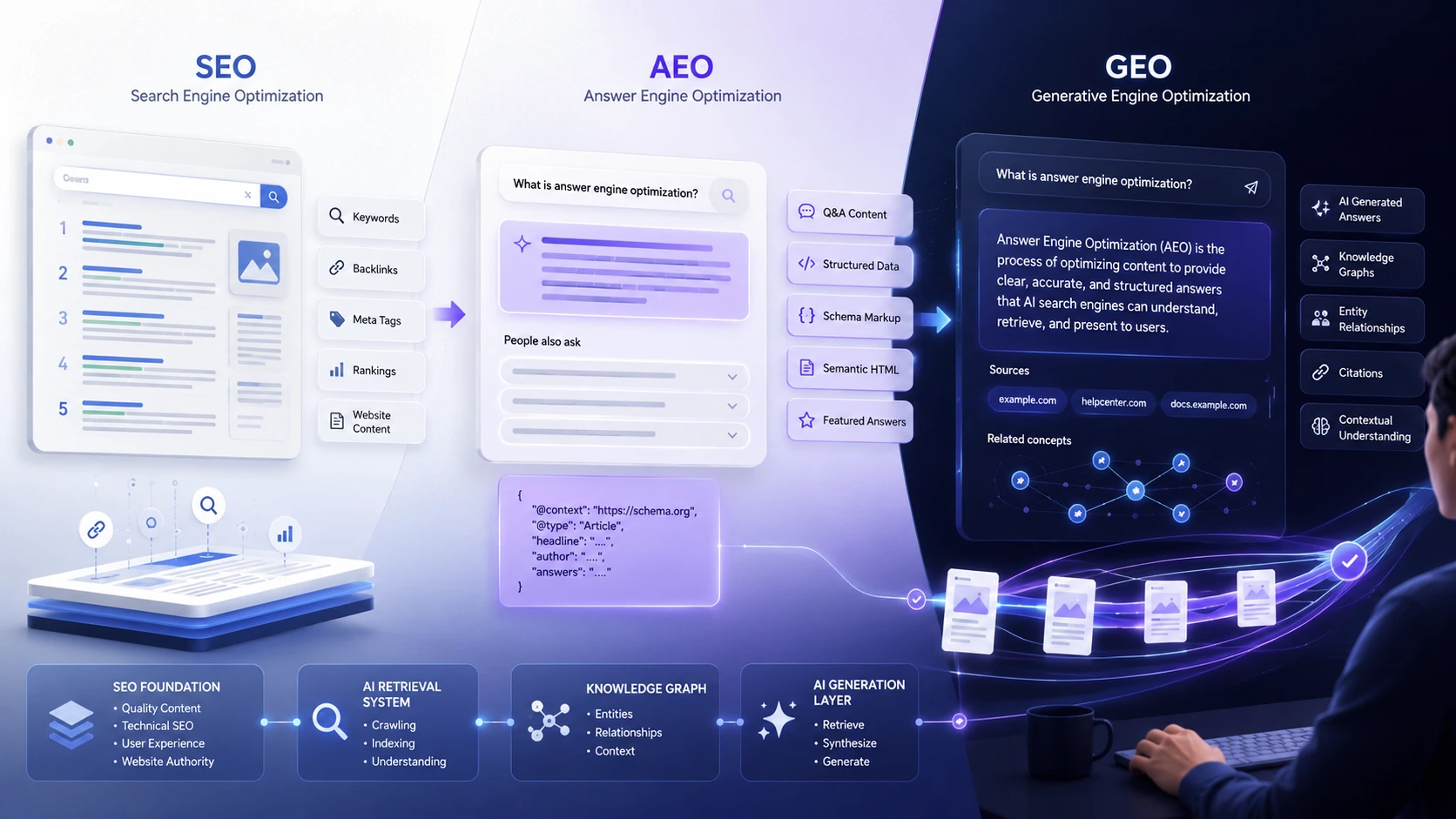
SEO → AEO → GEO
Where:
- SEO helps search engines discover, index, and rank content.
- AEO helps search systems extract clear answers from content.
- GEO improves the likelihood that AI-powered search experiences select, mention, and cite content.
What Is SEO (Search Engine Optimization)?
The Foundation of Search Visibility
Search Engine Optimization is the process of improving a website so search engines can crawl, understand, index, and rank its content.
The goal of SEO is:
Make valuable content discoverable for users searching for relevant information.
SEO focuses on:
- Keyword research
- Search intent
- Technical SEO
- Website architecture
- Content quality
- Internal linking
- Backlinks
- User experience
- Structured data
- Website performance
Example:
A user searches:
“Best project management software”
SEO helps a relevant website appear in organic search results.
Traditional search journey:
User Search
↓
Search Engine Results
↓
User Clicks Website
↓
Website Visit
Although AI search is growing, SEO remains essential because AI systems still depend heavily on indexed, accessible, and authoritative web content.
What Is AEO (Answer Engine Optimization)?
Optimizing Content to Become the Answer
Answer Engine Optimization focuses on creating content that search engines and AI systems can easily understand, extract, and use to answer user questions.
The goal of AEO is:
Make your content the clearest and most useful answer available.
AEO applies to:
- Featured snippets
- People Also Ask results
- Voice search
- Direct answer results
- AI-generated summaries
Example of AEO
Traditional SEO approach:
Title:
Schema Markup Guide
Goal:
Rank for:
schema markup
AEO approach:
Heading:
What Is Schema Markup?
Direct answer:
Schema markup is structured data added to webpages that helps search engines understand content and display enhanced search results.
This format makes information easier for search systems to extract.
How to Implement AEO
1. Create Question-Based Content
Search behaviour is becoming increasingly conversational.
Users often search using questions.
Examples:
Instead of:
Google Ads Conversion Tracking
Create:
How Does Google Ads Conversion Tracking Work?
Instead of:
Entity SEO
Create:
What Is Entity SEO and Why Is It Important?
Question-focused content aligns with modern search behaviour.
2. Provide Direct Answers
Search systems prefer content that answers questions clearly.
Example:
What Is Entity SEO?
Entity SEO is an optimization approach that helps search engines understand topics, people, organizations, products, and concepts as connected entities rather than only matching keywords.
After the direct answer, provide detailed explanations, examples, and supporting information.
3. Structure Content for Machine Understanding
AI systems extract information more effectively from well-organized content.
Useful formats include:
- Definitions
- Lists
- Tables
- Comparisons
- Step-by-step guides
- FAQs
Clear structure improves understanding for both users and machines.
4. Use Structured Data Correctly
Structured data helps search engines and AI systems understand webpage information.
Common schema types include:
- Article Schema
- Product Schema
- Review Schema
- Organization Schema
- Person Schema
- HowTo Schema
- FAQ Schema
However, schema markup should not only be viewed as a method for gaining visible rich results.
Google has retired FAQ rich results from Search, meaning FAQPage schema no longer produces expandable FAQ snippets in Google Search results.
However, FAQ Schema can still provide machine-readable information that helps systems understand question-and-answer relationships within content.
The modern value of schema includes:
- Better machine understanding
- Clearer entity relationships
- Improved content interpretation
- Support for AI-powered search experiences
Schema improves understanding but does not guarantee rankings, rich results, or AI citations.
What Is GEO (Generative Engine Optimization)?
Optimizing for AI-Generated Search Responses
Generative Engine Optimization focuses on increasing the probability that AI-powered search experiences mention, recommend, or cite your content.
The goal of GEO is:
Become a trusted source that AI systems select when generating answers.
How AI Search Systems Find Information
A common misunderstanding is that AI systems simply read the entire internet whenever they answer a question.
In reality, modern AI search experiences generally combine:
- Search indexes
- Retrieval systems
- Ranking algorithms
- Large language models
A simplified process:
User Question
↓
AI Search Experience
↓
Retrieval System
↓
Search Index / Web Sources
↓
Relevant Content Retrieved
↓
AI Model Generates Response
↓
Sources May Be Cited
The AI model generates the answer, but the retrieval system determines which sources are considered.
Therefore:
GEO depends on strong SEO foundations because content must first be discoverable and retrievable before AI systems can cite it.
Understanding AI Search Experiences and AI Models
It is important to distinguish between AI-powered search products and the AI models that generate responses.
AI Search Experiences
Examples:
- Google AI Overviews
- Google AI Mode
- ChatGPT Search
- Perplexity AI Search
These are user-facing experiences where people search for information.
AI Models
Examples:
- Gemini models
- GPT models
- Claude models
These are underlying artificial intelligence systems that process information and generate responses.
For example:
Google Search
↓
AI Overviews / AI Mode
↓
Gemini Models
GEO is not about optimizing separately for individual AI models.
It is about improving visibility across the complete retrieval and generation process.
How to Implement GEO
1. Build Strong Entity Signals
Modern search systems understand entities, not only keywords.
Entities include:
- People
- Organizations
- Products
- Locations
- Concepts
Websites should clearly communicate:
- Who created the content
- What expertise the website represents
- Relationships between topics
- Brand identity
Important elements:
- About pages
- Author profiles
- Organization Schema
- Person Schema
- Consistent brand information
- External mentions
2. Create Original and Experience-Based Content
AI systems have fewer reasons to cite generic information because similar content exists everywhere.
Strong GEO content includes:
- Original research
- Case studies
- Experiments
- Industry analysis
- Unique insights
Example:
Generic:
Website speed affects SEO.
Better:
Website performance affects user experience metrics such as Core Web Vitals, including Largest Contentful Paint (LCP), Interaction to Next Paint (INP), and Cumulative Layout Shift (CLS).
3. Increase Fact Density
AI systems prefer information that reduces uncertainty.
Useful GEO signals include:
- Statistics
- Research findings
- Data points
- Measurements
- Verified facts
Content supported by evidence is easier for AI systems to trust and reference.
4. Use Authoritative Sources
AI systems evaluate trust signals.
Support important information with:
- Government sources
- Academic research
- Industry reports
- Official documentation
Reliable references strengthen content credibility.
5. Include Expert Perspectives
Unique perspectives make content more valuable.
Examples:
- Expert interviews
- Professional analysis
- Industry commentary
- Research contributions
These elements create information that AI systems may consider more useful.
6. Build Topic Authority
Modern optimization requires more than ranking individual keywords.
Create topic clusters.
Example:
Entity SEO
├── What Are Entities in SEO?
├── Google Knowledge Graph Explained
├── Schema Markup Guide
├── Entity-Based Content Strategy
└── How Search Engines Understand Entities
This helps search systems understand topical expertise.
7. Make Content Technically Accessible
Technical accessibility remains important.
Although modern search engines can render JavaScript, heavy client-side rendering may create challenges for some AI crawlers and retrieval systems.
Best practices:
- Use server-rendered HTML for important content
- Avoid hiding critical answers behind JavaScript
- Keep important information available in initial HTML
- Use semantic HTML
Preferred approaches:
- Server-Side Rendering (SSR)
- Static Site Generation (SSG)
- Pre-rendered HTML
Important content includes:
- Definitions
- Product information
- Key answers
- Important explanations
8. Manage AI Crawlers
AI-related crawlers include:
- GPTBot
- OAI-SearchBot
- PerplexityBot
- ClaudeBot
- Google-Extended
Website owners can manage crawler access through:
- robots.txt
- Server rules
- Access controls
However:
Allowing AI crawlers does not guarantee citations.
It only enables access.
AI visibility depends on:
- Content quality
- Authority
- Relevance
- Trust signals
SEO vs AEO vs GEO
Feature | SEO | AEO | GEO |
Main Goal | Improve search visibility | Become a direct answer | Gain AI citations and mentions |
Environment | Traditional search engines | Featured snippets, answer systems, AI answers | AI-powered search experiences |
Focus | Discovery, rankings, authority | Answer extraction and understanding | Selection, recommendation, citation |
Success Signals | Rankings, traffic, impressions | Answer visibility | AI references and mentions |
Relationship | Foundation | Content optimization layer | AI visibility layer built on SEO + AEO |
How SEO, AEO, and GEO Work Together
They are connected layers:
GEO
|
—————-
| |
AEO SEO
| |
Answer Understanding Discovery + Authority
|
Technical Foundation
Simple explanation:
SEO → Can AI find you?
AEO → Can AI understand your answer?
GEO → Will AI choose and cite you?
What Should Websites Prioritize Today?
Step 1: Strengthen SEO Foundations
Focus on:
- Technical SEO
- Indexability
- Content quality
- Authority
Step 2: Improve AEO
Focus on:
- Question-based content
- Clear answers
- Structured formatting
- Schema markup
Step 3: Prepare for GEO
Focus on:
- Entity authority
- Original research
- Reliable citations
- Brand recognition
- AI-friendly content
The Future of Search Optimization
Search is moving from:
“How do I rank for this keyword?”
towards:
“How do I become the most trusted source for this topic?”
The future of optimization combines:
- Technical SEO
- Helpful content
- Structured data
- Entity optimization
- Author credibility
- Original research
- AI-friendly content structures
SEO is not disappearing.
It is expanding into a broader discipline where websites must not only rank in search engines but also become trusted sources for AI-generated answers.