

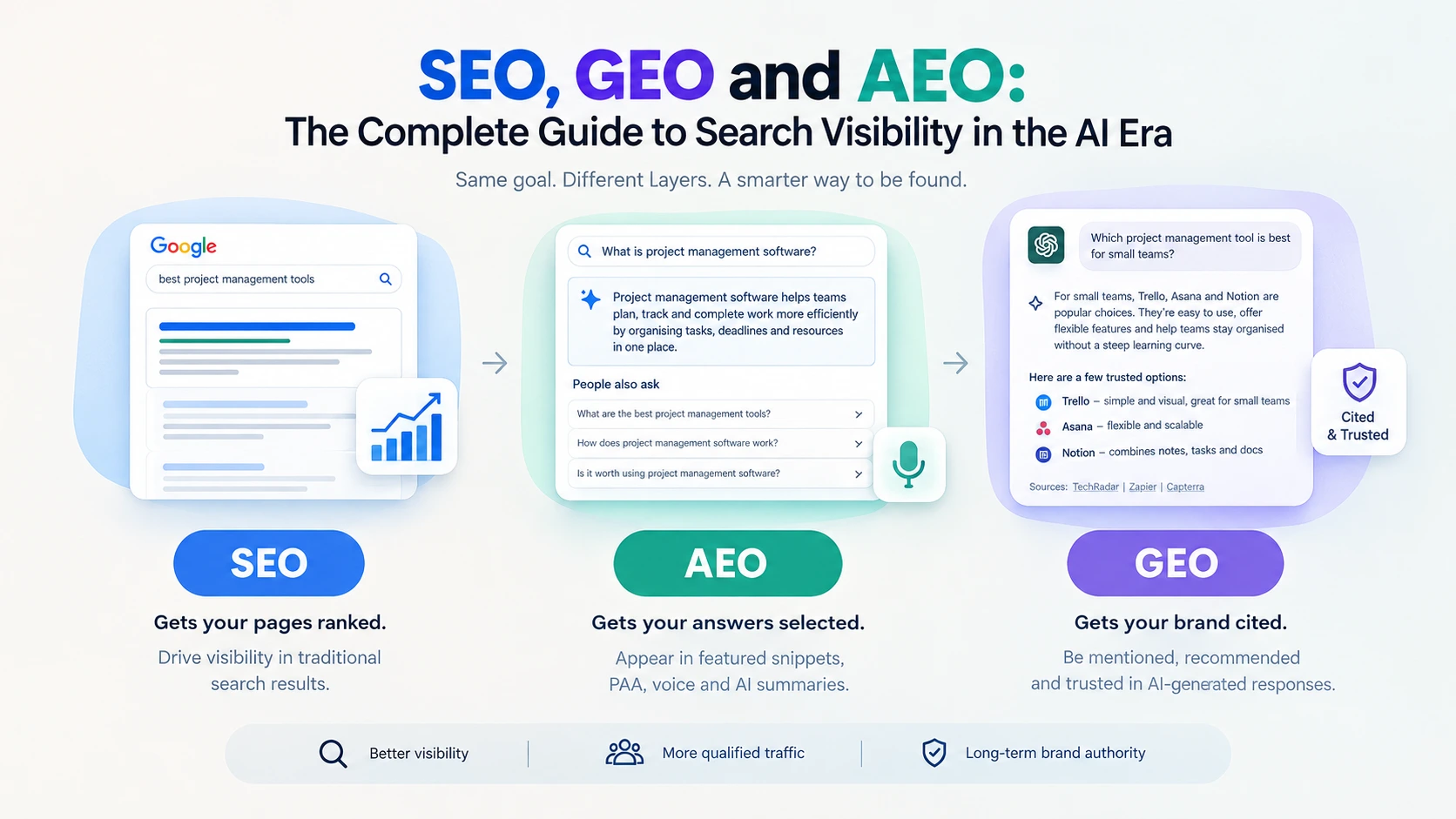
SEO gets your pages ranked. AEO gets your answers selected. GEO gets your brand cited inside AI-generated responses. They share one foundation: helpful, accurate, well-structured content from a source people and machines trust. Treat them as three layers of the same strategy, not three separate projects.
Why this conversation matters now
For two decades, search visibility meant one thing: a blue link on page one. That is no longer the whole picture. People now get answers from Google’s AI features, ChatGPT, Gemini, Perplexity, Copilot and voice assistants, often without clicking anything.
That changes what “being visible” means. You can rank well and still never be mentioned in the answer. You can be mentioned in the answer and receive no click. And a competitor with weaker rankings can be recommended by an AI system simply because their brand is clearer, better documented and more widely trusted.
This guide explains the three disciplines, shows where they overlap, and gives you a practical plan. It is direct on purpose: much of what is written about GEO and AEO is either hype or a rebrand of basic SEO. The truth sits between those two.
What is SEO?
Search engine optimization (SEO) is the practice of improving your website so search engines can crawl, understand and rank it for relevant queries.
It rests on four pillars:
- Technical health: crawlability, indexation, site speed, mobile usability, clean architecture, correct canonicals and redirects.
- Content relevance: pages that match search intent better than competing pages.
- Authority: links and mentions from credible sources that signal trust.
- Experience: a site that is fast, clear and easy to use.
Goal: rank higher and earn clicks.
Success metrics: rankings, impressions, organic clicks, organic conversions.
SEO is not dead, and it is not being replaced. It is the foundation the other two layers stand on, because AI systems still rely heavily on indexed, crawlable, high-quality web content.
Intent matters here. AI answers dominate informational queries (“what is…”, “how does…”). Commercial and transactional queries (“best…”, “buy…”, “near me”) still send far more people to ranked pages, product listings and maps. Decide which intents drive your revenue before deciding how much to invest in AEO and GEO.
What is AEO?
Answer engine optimization (AEO) is the practice of structuring your content so it can be selected as the direct answer to a question: featured snippets, “People also ask” boxes, knowledge panels, voice assistant responses and AI summaries.
AEO is not new. It grew out of featured snippet optimization and voice search. What has changed is the number of places that extract and present answers.
What AEO looks like in practice:
- A question as a heading, followed by a direct answer in the first one or two sentences.
- Short, self-contained answer paragraphs, roughly 40 to 60 words, that make sense when lifted out of the page.
- Lists for steps, tables for comparisons, definitions for terms.
- FAQ sections that answer real questions, not keyword-stuffed filler.
- Supporting schema markup where it genuinely matches the visible content.
Goal: be the answer.
What is GEO?
Generative engine optimization (GEO) is the practice of making your brand, content and data likely to be retrieved, trusted and cited by generative AI systems when they compose answers.
The difference from AEO is important. An answer engine selects one extract from one page. A generative engine synthesises an answer from many sources, then decides which sources and brands to mention. You are not competing for a position. You are competing to be included in the synthesis.
Under the hood, most AI search products use retrieval-augmented generation (RAG): they retrieve relevant passages, often by matching meaning rather than exact keywords, and a language model then writes an answer from what was retrieved. The practical consequence is that passages, not whole pages, get retrieved. Each key passage should be clear, specific and understandable on its own.
GEO focuses on:
- Entity clarity: AI systems need to know exactly who you are, what you offer and how you relate to your topic. Consistent naming, descriptions and facts across your site and the wider web make you easier to recognise.
- Citable content: original data, clear definitions, expert commentary, specific examples and verifiable claims give a model something worth quoting.
- Third-party corroboration: reviews, press coverage, directories, industry mentions and community discussions (forums, Reddit, review sites) confirm what your own site says. Brands that are repeatedly discussed alongside a topic by credible third parties tend to be easier for AI systems to associate with it. Treat that as an observed pattern, not a documented formula.
- Retrievability: your content must be crawlable, indexable and readable without heavy scripting, because many AI products retrieve from a search index at answer time.
- Freshness and accuracy: outdated or contradictory information is less likely to be trusted.
Goal: be mentioned, recommended and cited.
SEO vs AEO vs GEO at a glance
| SEO | AEO | GEO | |
|---|---|---|---|
| Core question | Can people find my page? | Is my answer the one selected? | Is my brand included in AI-written answers? |
| Main target | Search results pages | Snippets, PAA, voice, answer boxes | ChatGPT, Gemini, Perplexity, AI Overviews |
| Unit of optimisation | Page | Passage | Brand, entity and passage |
| Winning content | Comprehensive, intent-matched | Direct, concise, structured | Original, credible, corroborated |
| Key signals | Relevance, links, UX, technical health | Clarity, structure, markup | Authority, entity consistency, third-party mentions |
| Typical outcome | Click | Answer shown, sometimes click | Mention or citation, sometimes click |
| Primary metric | Rankings and organic traffic | Snippet and answer presence | Citations and AI share of voice |
| Discovery mechanism | Index matching and ranking signals, including links | Passage ranking and snippet extraction | Retrieval of sources, then AI synthesis |
How the three connect
Think of it as a stack:
- SEO is the base. If search engines cannot crawl, index and trust your site, nothing above it works.
- AEO is the format layer. It shapes your content so extraction is easy.
- GEO is the reputation layer. It determines whether AI systems see your brand as a credible source worth naming.
Skip the base and your answers never get found. Skip the format layer and your good content is hard to extract. Skip the reputation layer and you are retrievable but never recommended.
What actually works: a practical framework
Step 1: Fix the foundation (SEO)
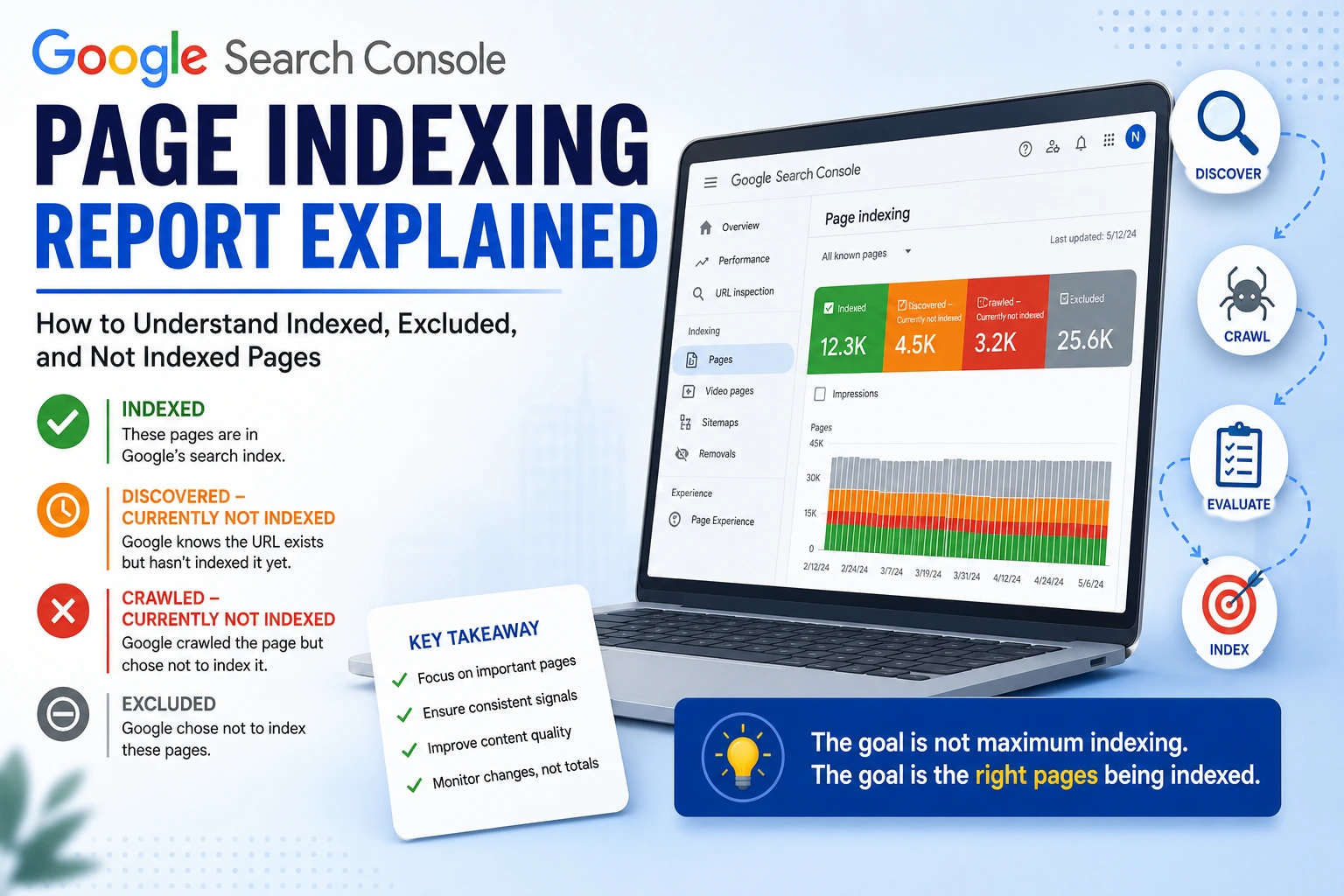
- Make sure every important page is crawlable and indexable. Check robots.txt, noindex tags, canonicals and sitemaps.
- Keep your site fast and mobile-friendly. Server-render the content that matters rather than hiding it behind JavaScript.
- Build a clear site structure with logical internal linking.
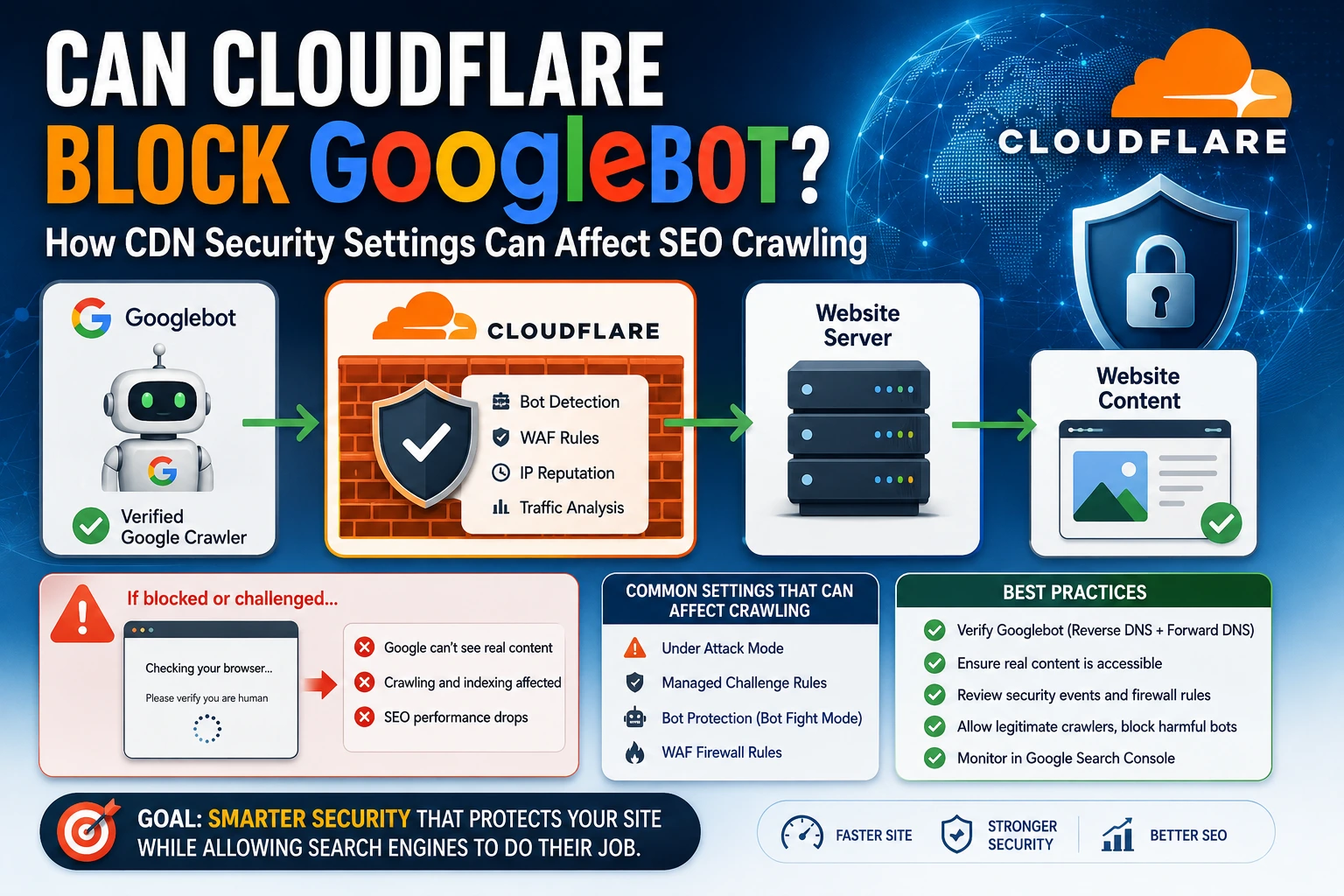
- Decide deliberately which AI crawlers you allow. Blocking them may protect content, but it can also remove you from AI answers. Make that a business decision, not an accident.
Step 2: Match intent and answer it fast (AEO)
- Research the questions your audience actually asks: search suggestions, “People also ask,” customer support tickets, sales calls and community forums.
- Put the direct answer first, then the nuance. A reader, a snippet and a language model all benefit from the same structure.
- Use descriptive headings that mirror real questions.
- Use real lists, tables and definitions instead of burying facts in long paragraphs.
- Add FAQ content only where people genuinely have those questions.
Step 3: Make your content worth citing (GEO)
- Publish something original. Surveys, benchmarks, case studies, internal data, expert interviews and first-hand experience are what generic AI-written content cannot replicate. Think of it as information gain: add something a reader cannot already find on the pages that rank. Google has described information-gain scoring in patents, but a patent does not prove how any live system works, so treat it as a sound editorial test rather than a known ranking factor.
- Be specific. Named tools, real numbers, dated claims and concrete examples are more quotable than general advice.
- Show real authorship. Named authors with relevant credentials and visible experience strengthen trust.
- Cite your own sources. Content that references reputable evidence is easier to verify.
- Keep it current. Update important pages and show the revision date honestly.
Step 4: Build your entity and your footprint (GEO)
- Use identical brand name, description, address and key facts everywhere: website, social profiles, directories, Google Business Profile, Wikipedia or Wikidata where eligible, and industry listings.
- Create clear About, Author and Contact pages.
- Earn mentions from credible third parties: industry publications, partner sites, review platforms, podcasts and community discussions.
- Encourage genuine customer reviews on the platforms your audience trusts.
- Be present where AI systems learn about your category, including forums and Q&A communities, but contribute honestly rather than promotionally.
Step 5: Use structured data sensibly
- Implement schema that matches visible page content: Organization, Article, Product, FAQ where appropriate, LocalBusiness, Review and BreadcrumbList.
- Connect entities with consistent identifiers and “sameAs” references to your official profiles, including Wikidata or Wikipedia entries where you qualify. Knowledge graphs identify brands as entities, not text strings, so a name written three different ways can read as three different companies.
- Validate markup and keep it accurate. Schema does not guarantee any feature or citation. Its job is to remove ambiguity.
Step 6: Measure what is measurable
- SEO: impressions, clicks, rankings and conversions from Google Search Console and analytics.
- AEO: which queries trigger snippets or answer boxes for you, and which go to competitors.
- GEO: run a fixed set of 20 to 50 priority prompts across major AI platforms monthly. Record whether you are mentioned, how you are described, which sources are cited and which competitors appear. In GA4, create a custom channel group for AI referrers such as chatgpt.com, perplexity.ai, gemini.google.com and copilot.microsoft.com. Expect undercounting, because some AI apps strip the referrer and their visits land in direct.
Be realistic. AI answers vary between sessions and platforms, so GEO measurement shows trends, not precise rankings. Judge direction over months, not single results.
Common myths and mistakes
“SEO is dead.” No. AI search products lean heavily on web indexes and on pages that already perform well in search. Weak SEO usually means weak AI visibility.
“GEO is just SEO with a new name.” Partly true, and also incomplete. The fundamentals overlap heavily, but GEO adds real emphasis on brand entity strength, off-site corroboration and being quotable inside a synthesised answer.
“There is a secret trick.” Be wary of anyone selling one. Google has stated that its AI features do not require special optimisation beyond good SEO practice, and no one outside these platforms can guarantee a citation.
“Add an llms.txt file and you’re done.” Treat this as an experiment at best. There is no reliable evidence that major AI platforms use it as a ranking or citation signal, so never let it replace real content work.
“Stuff the page with FAQ schema.” Markup without matching, useful visible content is wasted effort and can harm trust.
“Mass-produce AI content to cover every question.” Thin, undifferentiated content gives AI systems no reason to cite you. Depth, originality and accuracy are the advantage.
“Only clicks matter.” In AI search, being named and recommended influences decisions even when no click occurs. Track brand search demand and direct traffic alongside organic clicks.
A quick optimisation checklist
Foundation
- Important pages are crawlable, indexable and fast
- Clean site structure with strong internal linking
- Deliberate policy on AI crawlers
Answer readiness
- Question-based headings with direct answers first
- Concise, extractable paragraphs, lists and tables
- Genuine FAQ sections
Citation readiness
- Original data, examples or expertise on key pages
- Named authors and transparent sourcing
- Fresh, accurate, consistent facts
Entity and trust
- Consistent brand information across the web
- Organization and relevant schema in place
- Reviews, press and third-party mentions growing
Measurement
- Search Console and analytics tracking set up
- Monthly AI prompt tracking with competitors
- AI referral traffic segmented
Frequently asked questions
What is the difference between SEO, GEO and AEO?
SEO improves how your pages rank in search results. AEO structures content so it is selected as a direct answer. GEO increases the likelihood that your brand is cited in AI-generated responses. They build on each other, with SEO as the foundation.
Do I need separate strategies for each?
No. Run one integrated content and authority strategy. Most tasks serve all three: clear content, strong technical health, credible authorship and a consistent brand presence. Add AEO formatting and GEO-specific tracking on top.
Can I guarantee citations in ChatGPT or Gemini?
No. These systems are probabilistic and change frequently. You can improve your odds by being crawlable, authoritative, specific and widely corroborated, but anyone promising guaranteed placement is overselling.
Is AEO the same as featured snippet optimisation?
It includes it but is broader. AEO also covers voice answers, knowledge panels, “People also ask” and answer extraction in AI summaries.
Which should a small business prioritise first?
Start with SEO fundamentals and your local and entity presence: a fast site, clear service pages, a complete Google Business Profile, consistent listings and genuine reviews. Then add answer-first content for the questions your customers ask most.
How long does it take to see results?
Technical and formatting fixes can show effects within weeks. Authority and entity building, which drive GEO outcomes, usually take several months of consistent work.
Does AI-generated content hurt visibility?
Content is not penalised merely for how it is produced, but low-value, unoriginal content performs poorly in search and gives AI systems nothing distinctive to cite. Use AI as an assistant, and add expertise, data and editorial judgement.
If AI answers reduce clicks, how does GEO produce a return?
Through influence first and clicks second. Being named in an answer shapes shortlists and brand searches even when no one clicks. Some marketers report that visitors arriving from AI citations convert better, but the evidence is early and varies by site, so verify it with your own AI-referral segment before building a business case on it.
Is optimising for Google AI Overviews different from optimising for ChatGPT?
Partly. Google’s AI features draw on Google’s own index and ranking systems, so classic SEO carries over directly. Other assistants retrieve from their own mix of sources, and without web access they answer largely from training data. For those, consistent brand mentions across the wider web matter more than any single page.
Conclusion
The acronyms will keep multiplying, but the principle is stable: be the most helpful, credible and clearly understood source on your topic, then make that easy for both people and machines to see.
Do the work in order. Secure the SEO foundation. Format for AEO so your answers can be extracted. Invest in GEO so your brand earns mentions beyond your own website. Measure honestly, and adjust as the platforms evolve.
The brands that win will not be the ones chasing every new label. They will be the ones whose expertise is so clear, consistent and well documented that search engines rank them, answer engines select them and generative engines recommend them.
Pingback: Google November 2026 Core Update: What to Do and What to Avoid
Pingback: ChatGPT Business Hub: What Mentions and Clicks Mean